 Agubi Men's Health
What Are Prostate Stones? Causes, Symptoms, and When to Worry
Prostate stones are common, usually harmless, and often found by accident. Here is the honest version of what they are and when they actually matter.
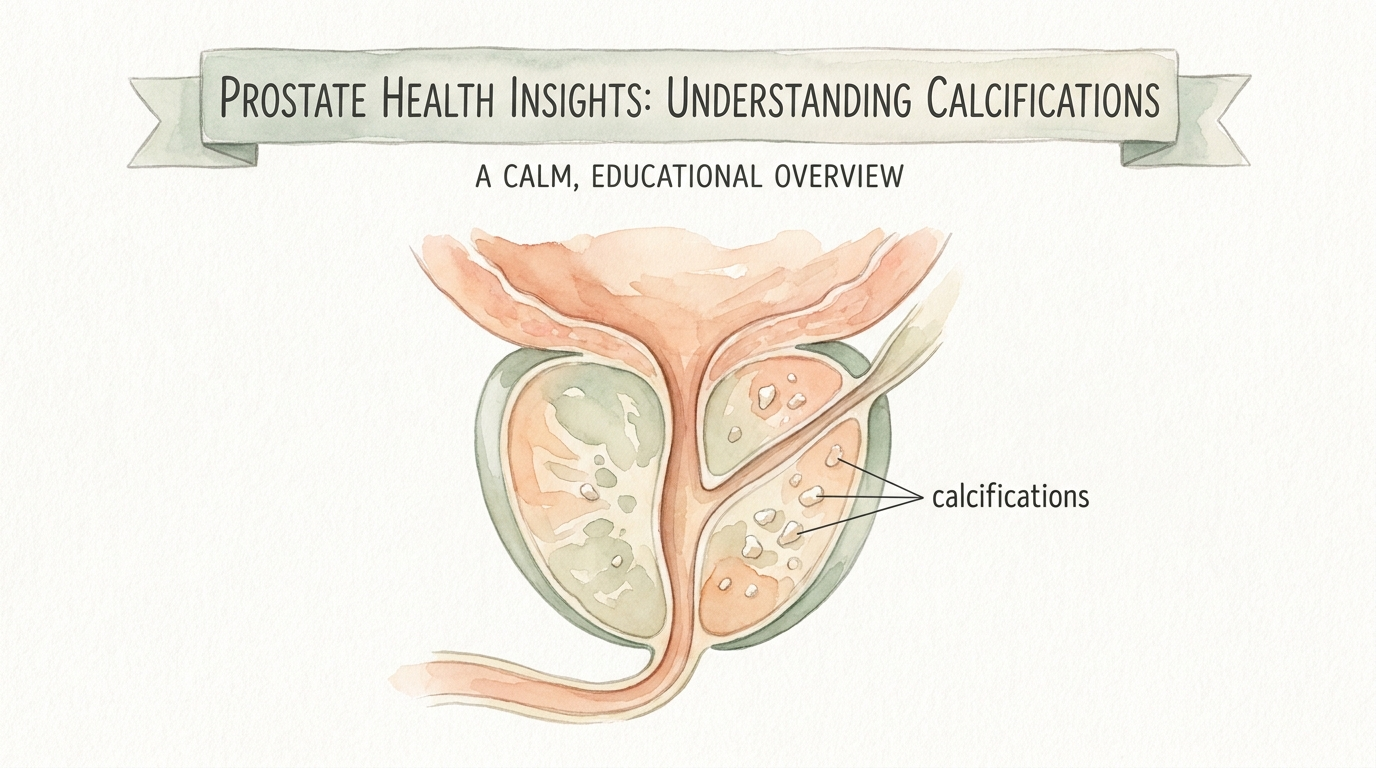
Prostate stones, also called prostatic calculi, sound dramatic. The reality is usually boring. They are small calcified deposits that form inside the prostate, often silently, and are usually discovered by accident during imaging done for some other reason.
Most men who have prostate stones never know it. Most men who do know it never need treatment. The condition is more interesting for the worry it generates than for the harm it causes.
Here is a calm, honest look at what prostate stones actually are, what they cause, and when they deserve attention.
What prostate stones actually are
Prostate stones are small, hard deposits that form within the ducts and tubules of the prostate gland. They are made of calcium phosphate, calcium carbonate, and other minerals, often mixed with cellular debris and prostatic fluid proteins.
There are two main types:
- Endogenous stones. Form within the prostate itself, usually in the acini (small glandular sacs). These are by far the most common. They tend to be small, multiple, and located near the urethra.
- Exogenous stones. Form from material that has refluxed backward from the urinary tract into the prostatic ducts. Less common. They tend to be larger.
Prostate stones are remarkably common. Autopsy studies suggest they are present in some form in 70 to 90 percent of men over 50, depending on how carefully you look. They are usually too small to see on standard imaging.
How they form
The exact mechanism is not fully understood, but several factors contribute.
Stasis of prostatic fluid. When prostatic fluid sits in the ducts longer than usual, minerals can precipitate out and form small stones. Less frequent ejaculation may contribute, though the evidence is thin.
Chronic inflammation. Prostatitis, particularly chronic prostatitis or CPPS, is associated with stone formation. Inflammation alters the local chemistry and encourages calcification.
Reflux of urine. Urine flowing backward into the prostatic ducts can deposit crystals that become stone nuclei.
Age. Stones accumulate over the decades, much like dental tartar or vascular plaques.
None of this means the stones are a problem. They are usually just incidental.
What symptoms they cause
Most prostate stones cause no symptoms at all. When symptoms do occur, they overlap heavily with prostatitis and BPH.
Possible symptoms include:
- Perineal discomfort or pressure
- Pain during or after ejaculation
- Blood in semen (hematospermia)
- Recurrent urinary tract infections
- Weak urine stream
These symptoms are not specific to stones. Most men with these symptoms have prostatitis, BPH, or both. The stones are usually an incidental finding on imaging rather than the actual cause.
One important caveat: prostate stones can occasionally harbor bacteria. This is one reason chronic bacterial prostatitis can be so hard to clear — bacteria hide inside the stones, shielded from antibiotics. When that happens, treatment gets harder but not impossible.
How they are found
Prostate stones are usually discovered incidentally.
- Transrectal ultrasound (TRUS). The most sensitive test. Small stones show up as bright echoes with shadows.
- CT scan. Will show larger stones clearly; misses very small ones.
- MRI. Less sensitive for calcifications than CT, but useful in overall prostate evaluation.
- Plain X-ray. Only useful for larger stones; misses smaller ones.
- Digital rectal exam. Cannot reliably detect stones, though very large or surface ones may be felt as gritty areas.
The incidental nature of most findings is worth emphasizing. Many men are diagnosed with prostate stones during an imaging workup for elevated PSA, infertility, or chronic pelvic pain, and then worry about the stones for years. The stones are usually not the problem.
When they actually need treatment
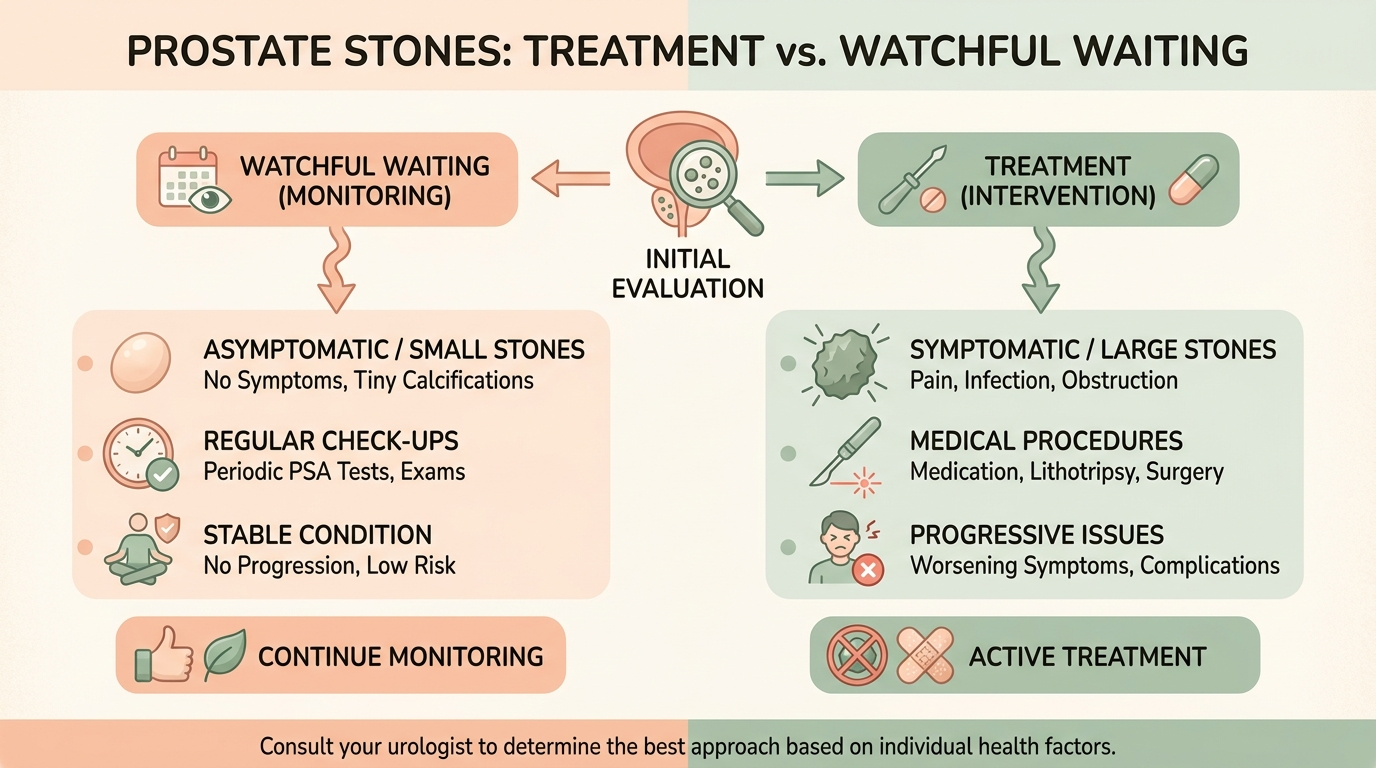
Most prostate stones need no treatment at all. Treatment is considered when:
- They are clearly associated with recurrent UTIs that do not respond to antibiotics
- They are linked to chronic bacterial prostatitis that keeps coming back
- They are causing significant pelvic pain that does not improve with other measures
- They are large enough to obstruct urinary flow (uncommon)
When treatment is needed, options include:
Antibiotics. For associated infection. May need prolonged courses (4 to 6 weeks or longer). Penetration into stones is limited, so recurrence is common.
Transurethral resection or laser lithotripsy. For symptomatic larger stones. A scope is passed through the urethra and the stones are fragmented or removed. Reserved for selected cases.
Prostate massage (medical). Sometimes used in chronic prostatitis associated with stones. Limited evidence.
Radical options. In severe, treatment-resistant cases with confirmed stone-related infection, prostatectomy has been done. This is rare and only when nothing else has worked.
For the vast majority of men, the answer is reassurance and watchful waiting.
What does not help
A few things are worth avoiding.
- Aggressive massage or prostate "draining." No evidence that this clears stones. Can inflame the prostate.
- Stone-dissolving supplements. No oral supplement reliably dissolves prostate stones. Phosphate-binding drugs have been tried with limited success and significant side effects.
- Long-term antibiotics without clear infection. Drives resistance without benefit.
- Surgery for incidental findings. Removing the prostate for stones found by accident is almost never appropriate.
Living with prostate stones
If you have been told you have prostate stones and feel fine, the most useful thing to do is accept the finding and move on. They are about as medically interesting as earwax.
If you have been told you have prostate stones and you have symptoms, the next step is figuring out whether the stones are actually causing the symptoms, or whether something else (BPH, prostatitis, pelvic floor dysfunction) is the real culprit. A urologist can help sort this out, often with a careful history and a focused exam rather than more imaging.
The stones themselves are not dangerous. They do not become cancer. They do not affect fertility in most men. They do not require surgery in the absence of clear, persistent symptoms.
The takeaway
Prostate stones are common, usually silent, and rarely a problem. The phrase sounds alarming, but the condition is more a curiosity than a disease.
Most men who know they have prostate stones need no treatment. A small minority with stones linked to recurrent infection or persistent symptoms benefit from targeted intervention, usually antibiotics, occasionally a procedure.
If you have just been told you have prostate stones and you feel fine, you probably do. If you have symptoms that are not improving, ask your doctor to look beyond the stones for the actual cause.
References
- Cleveland Clinic. Prostatic calculi.
- Drake T et al. Prostatic calculi. StatPearls. 2024.
- Kim SH et al. Chronic bacterial prostatitis and prostatic calculi. Prostate Int. 2013.
- Wein AJ et al. Campbell-Walsh Urology (12th ed.). Chapter on prostatitis.
Comments
article.commentNote
Loading…