 Agubi Men's Health
Prostate Cysts: Fluid-Filled Sacs That Are Usually Harmless
If your scan found a cyst on your prostate, here is what it actually means, what to watch for, and when (rarely) it needs attention.
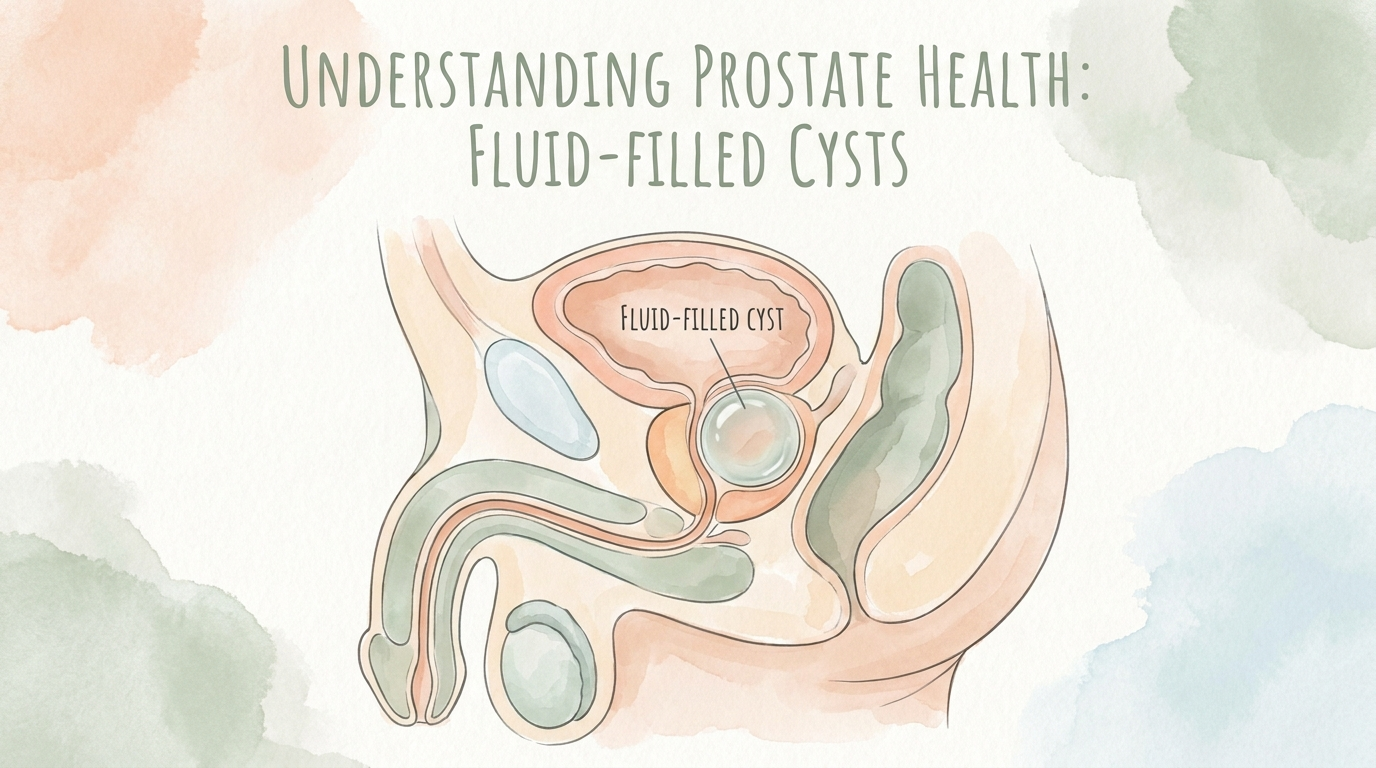
Most prostate cysts are discovered by accident, on an imaging scan done for some other reason. The report comes back with an unfamiliar word, the patient googles it, and a fairly ordinary anatomical finding starts to feel like a serious problem.
The reality is calmer than the search results suggest. Prostate cysts are usually benign fluid-filled sacs that have been quietly present, sometimes for years, doing nothing in particular.
This is a plain-language guide to what prostate cysts are, what they mean, and when (rarely) they need treatment.
What a prostate cyst actually is
A prostate cyst is a closed, fluid-filled sac within or adjacent to the prostate gland. They range from microscopic to several centimeters across. Most are lined by a thin membrane and filled with clear or slightly cloudy fluid.
Prostate cysts are categorized by where they sit and what they contain.
By location:
- Median (midline) cysts. Located in the center of the prostate, near where the ejaculatory ducts enter. The two main subtypes are prostatic utricle cysts and ejaculatory duct cysts. These are the most clinically important because of where they sit.
- Lateral (side) cysts. Located off to one side. More often associated with BPH or acquired cysts.
- Paraprostatic cysts. Outside the prostate proper, often near the seminal vesicles. Usually congenital.
By origin:
- Congenital cysts. Present from birth, often related to developmental variations of the Müllerian or Wolffian ducts.
- Acquired cysts. Develop later in life, usually in the setting of BPH, prostatitis, or obstruction of prostatic ducts.
In practice, the most common prostate cysts are small acquired cysts discovered incidentally in older men with BPH. They cause no symptoms and need no treatment.
How common they are
Cysts are common findings on imaging. MRI studies suggest some form of prostatic or periprostatic cyst in roughly 5 to 10 percent of men, with higher rates in older men and those with BPH. The true prevalence is hard to pin down because most are never imaged.
The vast majority are small (under 1 cm), asymptomatic, and discovered by chance.
What symptoms they cause
Most prostate cysts cause no symptoms. When they do, the symptoms usually relate to size and location, not the cyst itself being "diseased."
Possible symptoms include:
- Difficulty urinating, especially if the cyst is large enough to press on the urethra
- Pelvic or perineal discomfort or pressure
- Painful ejaculation
- Blood in semen (hematospermia)
- Infertility, particularly if the cyst is blocking the ejaculatory ducts
- Recurrent epididymitis or prostatitis
These symptoms are uncommon. They tend to appear only with cysts that are large (over 1.5 to 2 cm) or located in specific places where they obstruct normal anatomy.
When a cyst is actually a problem
Most prostate cysts are not. There are a few scenarios where they deserve attention.
Median cysts causing infertility. A prostatic utricle cyst or ejaculatory duct cyst can block the ejaculatory ducts, leading to low-volume ejaculate, painful ejaculation, or infertility. This is one of the few treatable causes of male infertility and is worth investigating in men with fertility concerns and low-volume ejaculate.
Cysts causing urinary obstruction. A large midline cyst can press on the prostatic urethra, mimicking BPH. Drainage or removal can relieve the obstruction.
Infected cysts. A cyst can become infected, usually in the setting of prostatitis. This causes pain, fever, and may require drainage plus antibiotics.
Cysts that look atypical on imaging. Very rarely, what looks like a simple cyst turns out to be a cystic tumor. Modern MRI with contrast can usually distinguish. When the appearance is unclear, further evaluation (PSA, follow-up imaging, sometimes biopsy) is warranted.
Outside these scenarios, the finding is reassuring rather than alarming.
How they are found and followed
Prostate cysts are usually found on imaging.
- Transrectal ultrasound (TRUS). The most common way to find them. Shows cysts as well-defined dark (anechoic) areas.
- MRI. Best for characterizing the cyst and its relationship to surrounding structures. Helps distinguish simple cysts from complex ones.
- CT. Less detailed for prostatic anatomy but will show larger cysts.
When a cyst looks simple on imaging (thin wall, clear fluid, no internal complexity), no follow-up is usually needed. If the cyst is complex (thick walls, internal septations, solid components, or blood), it warrants MRI and urology evaluation.
When treatment is needed
Treatment is reserved for cysts that are clearly causing problems.
Transurethral drainage or unroofing. For midline cysts causing obstruction or infertility. A scope is passed through the urethra and the cyst is opened. Often effective, sometimes definitive.
Transperineal or laparoscopic removal. For larger or more complex cysts. Less common.
Sclerotherapy. Injecting a sclerosing agent into the cyst to make it collapse. Used for recurrent cysts after drainage.
Antibiotics and drainage. For infected cysts. Aspiration plus culture-guided antibiotics.
For incidentally found simple cysts that are not causing symptoms, the right move is usually to leave them alone and reassure the patient.
What does not help
- Supplements or herbal "cysts cleanses." No evidence. They do not dissolve cysts.
- Prostate massage. Will not shrink a cyst and may inflame the prostate if done aggressively.
- Surgery for asymptomatic findings. Removing the prostate for an incidentally found cyst is almost never appropriate.
- Repeat imaging for stable simple cysts. Adds cost and worry without changing management.
Living with a prostate cyst
If you have just been told you have a prostate cyst and you feel fine, that is the most common situation. A simple cyst under 1 cm in an older man with BPH is about as exciting as a freckle.
The reasonable approach is:
- Confirm the cyst is "simple" on the imaging report (clear fluid, thin wall)
- If you have no urinary or fertility symptoms, no follow-up is needed
- If you have urinary symptoms or fertility concerns, mention the cyst to your urologist and ask whether it is in a position to be relevant
- If new symptoms develop (pain, infection, fertility changes), re-evaluation makes sense
The takeaway
Prostate cysts are common, mostly silent, and almost always benign. The word "cyst" sounds serious, but in this context it usually means a small fluid sac that has been quietly sitting there, doing nothing in particular.
Treatment is reserved for the rare cases where the cyst is large enough to obstruct, infected, blocking fertility, or has features that warrant closer evaluation. For everyone else, the right move is reassurance.
If your scan found a cyst and you feel fine, you probably do.
References
- Wein AJ et al. Campbell-Walsh Urology (12th ed.). Chapter on prostatic cysts.
- MedlinePlus. Prostate diseases.
- Aumüller G. Prostate cyst anatomy. Anat Embryol. 2011.
- Shebel HM et al. Cysts of the prostate gland. J Urol. 2012.
Comments
article.commentNote
Loading…