 Agubi Men's Health
Prostate Cancer: A Clear Guide for Men Who Just Got Diagnosed
If you or someone you love has just been told the word 'cancer,' here is the calm, clear, evidence-based version of what actually matters.
Most prostate cancers grow slowly. Many never become life-threatening. The 10-year survival rate for early prostate cancer is around 99 percent, a number worth holding onto. That said, the moment of diagnosis is disorienting. Here is a clear, calm version of what comes next.
What a prostate cancer diagnosis actually contains
A prostate cancer diagnosis is not one number. It is several, and each one shifts the picture.
PSA level. Higher numbers raise suspicion but are not a diagnosis. PSA can rise from BPH, prostatitis, or recent ejaculation.
Grade Group (modern Gleason). From 1 (most favorable) to 5 (most aggressive). Most diagnosed prostate cancers are Group 1 or 2.
Stage (I to IV). Stages I and II are localized. Stage IV has reached distant sites, usually bones.
Risk category. Doctors combine PSA, Grade Group, and stage into low, intermediate, or high. This drives the treatment conversation more than any single number.
The key insight: most prostate cancers are slow-growing, and most diagnosed today are low-risk.
What to do in the first week
After the biopsy report comes back, the days that follow feel heavy. A few practical steps help.
Bring someone to the next appointment. Two sets of ears catch more than one.
Ask for copies of everything. Pathology report, PSA history, imaging. They are yours.
Request a multidisciplinary review if available. Urologist, radiation oncologist, and medical oncologist look at the case together. Even one trip for this is usually worth it.
Pause before big decisions. For low-risk cancer, nothing urgent needs to happen in the first two weeks.

The treatment menu
Prostate cancer treatment has more legitimate options than almost any other cancer. That is both a gift and a burden: more choices, but also more decisions to make.
For low-risk prostate cancer
Most low-risk prostate cancers (Grade Group 1, low PSA, stage I or II) do not need immediate treatment. Active surveillance is now the standard of care for most men in this group.
Active surveillance means regular monitoring: PSA every 6 months, an MRI every 1 to 2 years, and repeat biopsies as needed. Treatment is reserved for signs that the cancer is progressing. About half of men on active surveillance never need treatment. The other half eventually do, and outcomes are the same as if treatment had been started immediately.
This is not "doing nothing." It is "doing the right amount." For men with low-risk disease, it is increasingly the standard recommendation, and the evidence supporting it is strong.
For intermediate-risk prostate cancer
The decision gets more nuanced. Options include:
- Radical prostatectomy (surgical removal). Modern robotic surgery has low complication rates. Side effects: temporary urinary incontinence, variable erectile dysfunction.
- Radiation therapy, external beam or brachytherapy (radioactive seeds). Similar outcomes to surgery for many men.
- Combined radiation and hormone therapy. For higher intermediate-risk cases.
For high-risk prostate cancer
Treatment is more aggressive. Usually a combination: radiation plus long-term hormone therapy (androgen deprivation), sometimes surgery. The goal is cure, but the trade-offs are larger.
For advanced or metastatic prostate cancer
Treatment is no longer aimed at cure but at long-term control. Hormone therapy is the backbone, with newer agents (abiraterone, enzalutamide, apalutamide) extending life meaningfully. PSMA-targeted radiation therapy and chemotherapy are used when needed. Many men with metastatic prostate cancer now live 10 or more years with good quality of life.
How to think about the choice
There is rarely one right answer. A few questions help clarify.
- What is my risk category, really? If low-risk, active surveillance is almost always worth considering. If high-risk, treatment is usually recommended.
- What does my urologist specialize in? Surgeons tend to recommend surgery; radiation oncologists tend to recommend radiation. Both are valid. A second opinion from the other specialty is wise.
- How do I feel about the side effects? Incontinence and erectile dysfunction are the two main concerns. Surgery has a higher short-term incontinence rate; radiation has a higher long-term bowel and bladder irritation rate. Both can affect sexual function.
- How old am I, and what is my overall health? A healthy 55-year-old has more decades to live with side effects than a 75-year-old with heart disease. The calculus changes.
- What does my gut tell me after two good consultations? Many men find their answer settles after hearing the same options explained twice.
What does not help
A few common instincts work against you here.
- Panic decisions in the first week. Low-risk prostate cancer does not change in two weeks. Take time.
- Secret supplements. No dietary supplement has been shown to slow or cure prostate cancer.
- Extreme diets. A heart-healthy diet helps generally; no specific diet cures cancer.
- Avoiding the conversation. Pretending the diagnosis is not real does not make it go away, and skipping follow-up on active surveillance has real consequences.
Living with prostate cancer
Whichever path you choose, life continues. Most men with prostate cancer live full, normal lives. Side effects from treatment are real and worth taking seriously, but they are usually manageable with time, pelvic floor physical therapy, and good medical support.
Sexual function changes are common. Erectile dysfunction after surgery or radiation is usually treatable with medication (PDE5 inhibitors), vacuum devices, or injections. Openness with your partner and your doctor matters more than any single intervention.
Urinary incontinence after prostatectomy improves steadily over months for most men. Pelvic floor physical therapy speeds recovery significantly.
Psychological effects are real too. A prostate cancer diagnosis is its own kind of event, and it is normal to feel fear, anger, or numbness. Talking with other men who have been through it, either in person or in well-run support groups, often helps more than expected.
The takeaway
A prostate cancer diagnosis is not the end of a story. For most men, it is the beginning of a long, manageable chapter. Survival rates are high, treatment options are real, and there is time to make thoughtful decisions.
If you are reading this in the days after your own diagnosis, the most useful thing you can do is slow down, gather your information, and find a care team you trust. The right decision for you will become clear when you are not rushing.
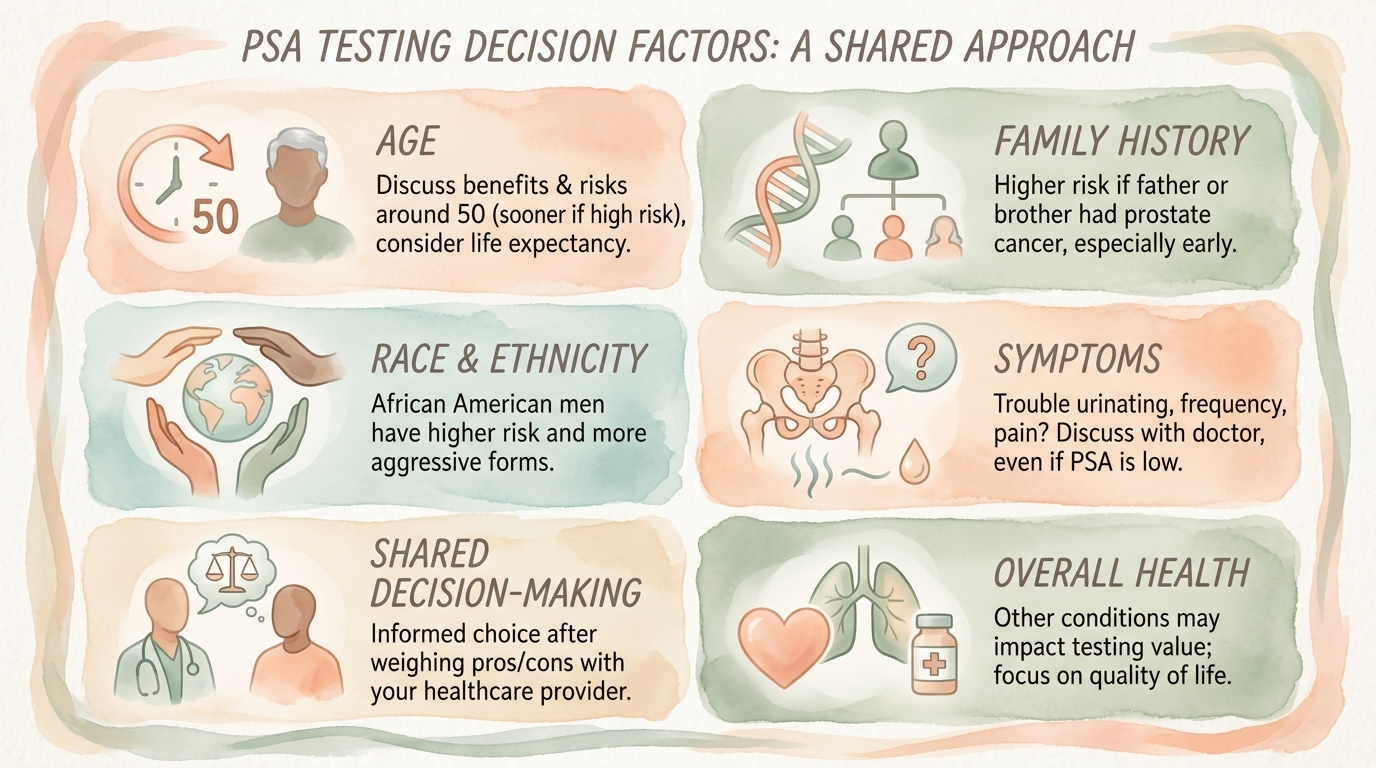
If you are reading this preventively, the most useful thing you can do is know your PSA history, your family history, and your risk category. A simple conversation with your doctor at 50 (or 45 with family history) is a good starting point.
Either way, the odds are strongly in your favor.
References
- American Urological Association. Prostate Cancer (2022 guidelines).
- National Comprehensive Cancer Network. Prostate Cancer Guidelines.
- Mayo Clinic. Prostate cancer: Diagnosis and treatment.
- Cleveland Clinic. Prostate Cancer.
- 中国前列腺癌诊断治疗指南 (2022 版).
Comments
article.commentNote
Loading…