 Agubi Men's Health
BPH: What an Enlarged Prostate Actually Feels Like, and What to Do About It
Benign prostatic hyperplasia affects roughly half of men over 60. Here is what the symptoms mean, what the tests show, and what actually helps.
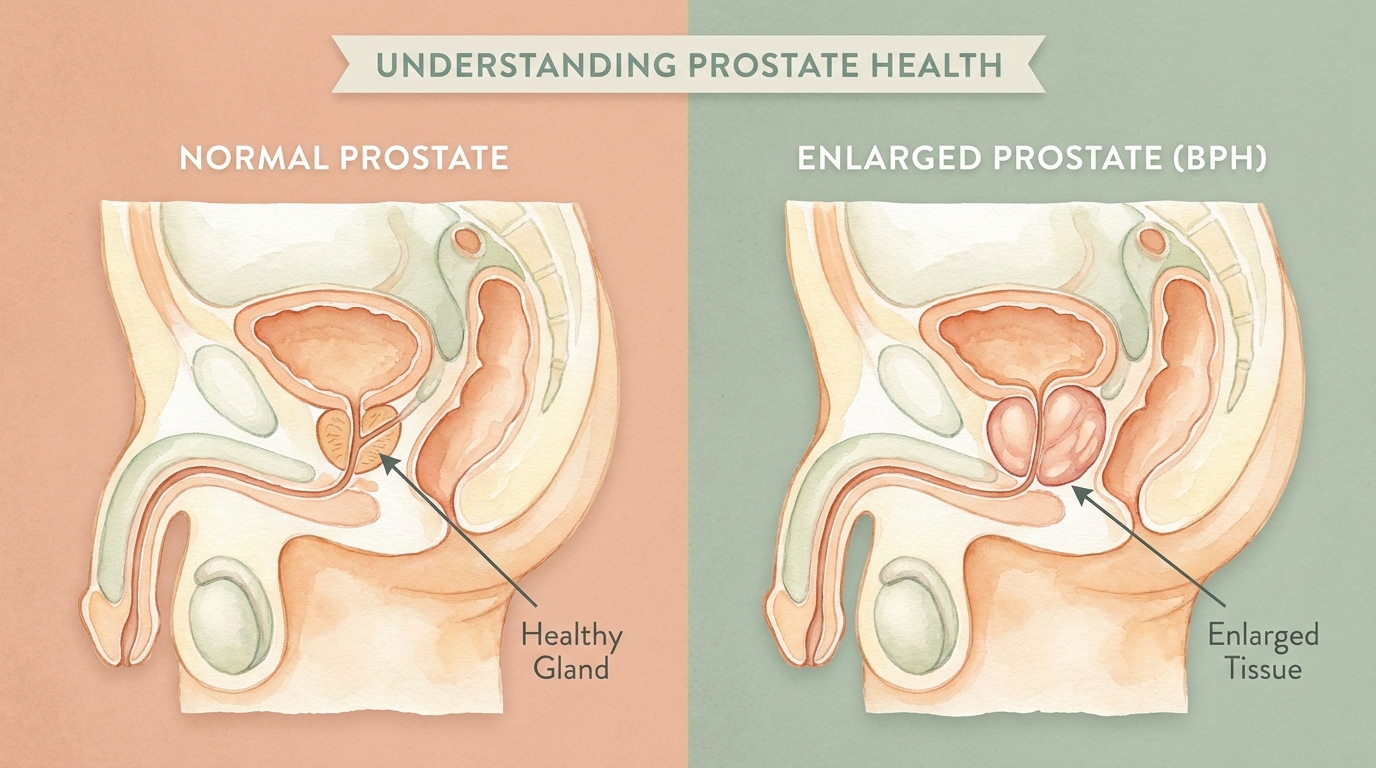
By the age of 60, about half of all men have some enlargement of the prostate. By 85, the number is closer to 90 percent. The medical term is benign prostatic hyperplasia, almost always shortened to BPH. "Benign" because it is not cancer. "Hyperplasia" because cells are multiplying more than they should. "Prostatic" because it is happening in the prostate.
Most men with BPH never need surgery. For those with bothersome symptoms, knowing what to ask for and what to try first is the difference between suffering for years and feeling meaningfully better.
What BPH actually is
The prostate surrounds the urethra, the tube that carries urine out of the bladder. As prostate cells multiply with age, the gland enlarges and gradually squeezes the urethra. This is the source of nearly every BPH symptom.
BPH is not prostate cancer, and having BPH does not increase your risk of getting prostate cancer. They are separate conditions. The confusion is common, because both involve the prostate and both become more common with age.
The growth is driven mainly by hormonal changes. Testosterone and its more potent cousin dihydrotestosterone (DHT) accumulate in prostate tissue over the decades. Treatments for BPH either block the hormones that drive growth, or relax the smooth muscle around the urethra to relieve pressure.
What it actually feels like
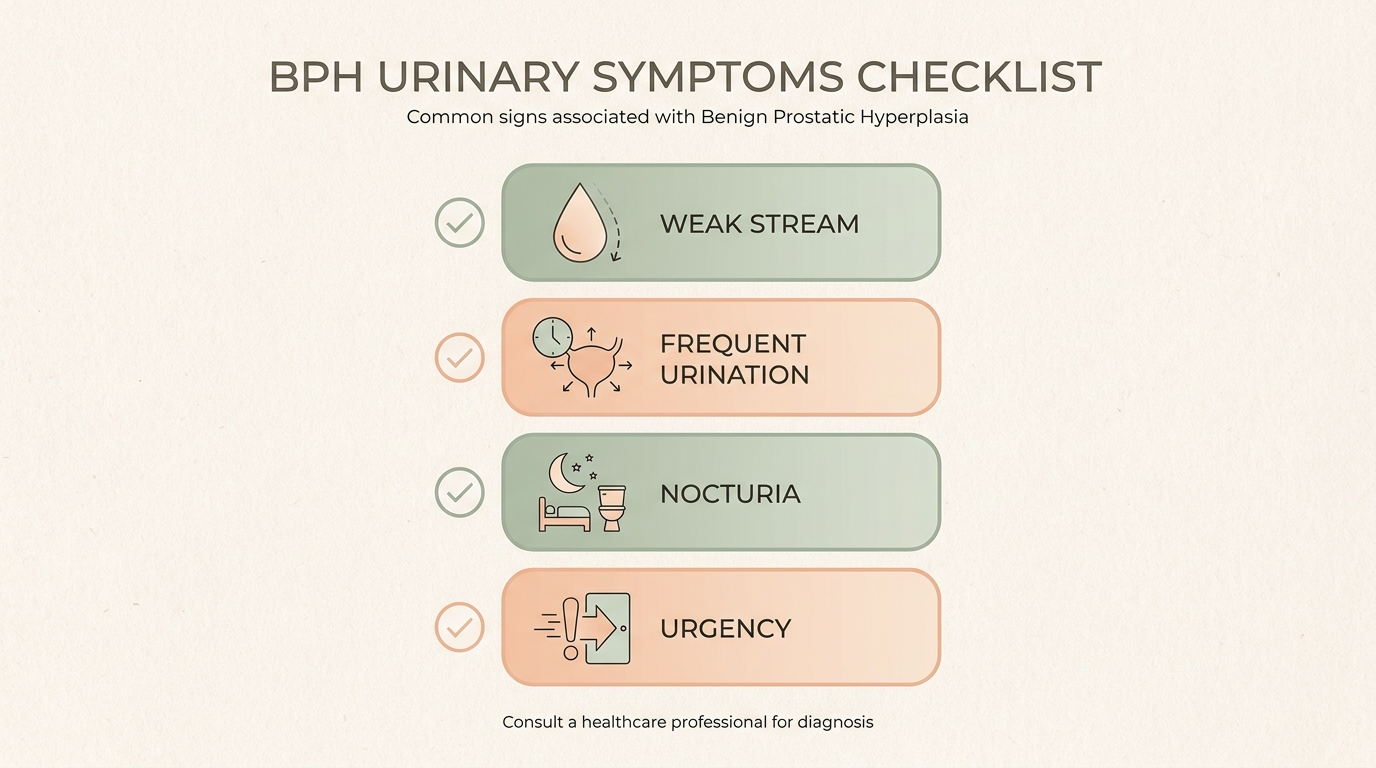
Storage symptoms (the bladder fills when it should not):
- Needing to urinate more often than usual, especially at night
- A sudden, hard-to-ignore urge to go
- Sometimes leaking before reaching the bathroom
Voiding symptoms (the bladder struggles to empty):
- A weak stream, or one that starts and stops
- Difficulty getting started
- Straining to finish
- A feeling that the bladder is not fully empty
- Dribbling at the end
Post-micturition symptoms: Sensation of incomplete emptying, continued dribbling.
Most men have a mix. The medical shorthand is LUTS (lower urinary tract symptoms). Severity is graded with the International Prostate Symptom Score (IPSS), an 8-question tool from 0 to 35. Mild is 0 to 7, moderate 8 to 19, severe 20+.
When BPH needs prompt attention
Most cases are gradual and manageable. A few scenarios call for same-day care:
- Complete inability to urinate (acute urinary retention)
- Severe pain in the lower abdomen
- Blood in the urine, especially with clots
- Fever plus urinary symptoms (suggesting infection)
- Painful, swollen prostate
Acute urinary retention is a true emergency. It usually requires a catheter to drain the bladder and a brief hospital visit. It often happens after surgery, prolonged travel with delayed urination, or with certain medications (antihistamines, decongestants, opioids). Knowing the trigger can sometimes prevent it.
How BPH is evaluated
The workup is straightforward and not uncomfortable.
Standard workup: IPSS questionnaire, digital rectal exam (DRE), PSA blood test, urine test, and kidney function check. Imaging is added when the picture is unclear.
Most men do not need every test. A careful history, exam, and PSA are usually enough to start.
What actually helps
Treatment follows a stepwise path based on how much the symptoms bother you.
Watchful waiting
For men with mild symptoms (IPSS 0 to 7) that do not bother them much, the right move is often no medication at all. Periodic check-ins, usually annually, to make sure things are not silently worsening. Roughly a third of men stay in this category for years.
Daily habits that genuinely help
A handful of changes consistently reduce symptoms:
- Limit evening fluids. Stop drinking large amounts 2 hours before bed.
- Reduce bladder irritants. Cut back on caffeine, alcohol, and carbonated drinks if they make urgency worse.
- Double voiding. After urinating, wait a moment, relax, and try again. Helps empty the bladder more completely.
- Schedule bathroom breaks. Going every 3 to 4 hours rather than waiting for urgency retrains the bladder.
- Stay active. Walking and gentle exercise improve urinary symptoms more than most men expect.

These are not magic, but they have evidence behind them and no side effects.
Medications
When symptoms are moderate to severe, two main drug classes are used, often together.
Alpha-blockers (tamsulosin, alfuzosin, silodosin). These relax the smooth muscle in the prostate and bladder neck, making it easier to urinate. They work within days. Side effects include retrograde ejaculation (semen enters the bladder instead of exiting) and sometimes dizziness. They do not shrink the prostate.
5-alpha-reductase inhibitors (finasteride, dutasteride). These block the conversion of testosterone to DHT, gradually shrinking the prostate over 6 to 12 months. They work slowly but durably. Side effects include reduced libido and erectile dysfunction in a minority of men. Best for men with significantly enlarged prostates (over 40 grams).
Combination therapy is increasingly common for men with both bothersome symptoms and a clearly enlarged prostate. The two drugs work in different ways and complement each other.
Anticholinergics or beta-3 agonists (mirabegron) are added when storage symptoms (urgency, frequency) dominate despite alpha-blocker therapy.
Procedures
When medication is not enough or causes too many side effects, several minimally invasive options exist:
- TURP (transurethral resection). The long-standing gold standard. Highly effective, durable results.
- Laser enucleation or vaporization. Similar to TURP with potentially less bleeding.
- Rezum. Steam injections, office-based, modest results.
- UroLift. Tiny implants that hold the urethra open, preserves ejaculation.
- Prostate artery embolization. A radiologic procedure, less commonly used.
The choice depends on prostate size, overall health, sexual function priorities, and surgeon experience. There is no single "best" option for everyone.
What does not help
Saw palmetto, zinc, selenium, and "prostate health" herbal blends lack consistent evidence in modern trials. The harm comes from spending money on unproven treatments while neglecting the ones that work.
The takeaway
BPH is common, gradual, and usually manageable. The first decision is whether the symptoms bother you enough to treat at all. For mild symptoms, lifestyle adjustments and time may be all you need. For moderate to severe symptoms, the medication options are well-studied and effective. For the small group that needs more, several minimally invasive procedures work well.
The most useful thing any man over 50 can do is know his IPSS score. It puts a number on something that otherwise feels vague, and it gives you and your doctor a clear way to track whether treatment is actually helping.
If you are getting up three times a night to urinate, or hesitating before starting your stream every morning, that is worth bringing up. Not as a crisis, but as a conversation.
References
- American Urological Association. Management of BPH (2021 amendment).
- Mayo Clinic. Benign prostatic hyperplasia (BPH).
- NIDDK (NIH). Prostate enlargement.
- MedlinePlus. Enlarged prostate.
- 中国泌尿外科疾病诊断治疗指南 (2019 版). BPH 章节.
Comments
article.commentNote
Loading…